

Level 1
The entry certification of the French training pathway: diving to twenty metres with an instructor, in five dives.
- Five sea dives, with no compulsory pool sessions
- Four students per instructor, maximum
- No performance required — what counts is being at ease
- Opens the way to PA 20 and then Niveau 2
- A dive computer lent free of charge
- Cancellation up to 7 days before the course, course kit excluded
- Email confirmation with the details of your trip
- State-qualified instructor State-qualified instructors
- Limited group size maximum 4 participants
How the course runs
Allow 5 dives, theory included.
-
Before you come
A medical certificate less than a year old. If you have never breathed underwater, we start with a try dive: it is the first immersion of the pathway.
-
The gear, end to end
Assembling and stripping the tank, BCD and regulator, checking the pressure before leaving, choosing your weights for the suit and the water. By the end you prepare your kit with nobody looking over your shoulder.
-
Getting in and moving around
Giant stride, backward roll, shore entry. Duck dive and seal dive to descend. Finning at the surface and underwater: we look for the right movement, not performance, and nothing is timed.
-
Breathing and holding your depth
Clearing your mask without stress, releasing and recovering the regulator, holding a depth on your lungs before touching the BCD. This is the skill that decides everything that follows.
-
Communicating and reacting
The signals: ok, up, down, reserve, something's wrong, out of air, cold, out of breath. Then the procedures: taking the guide's octopus, handing yours to a buddy, staying calm while you do it.
-
Ascending and getting out
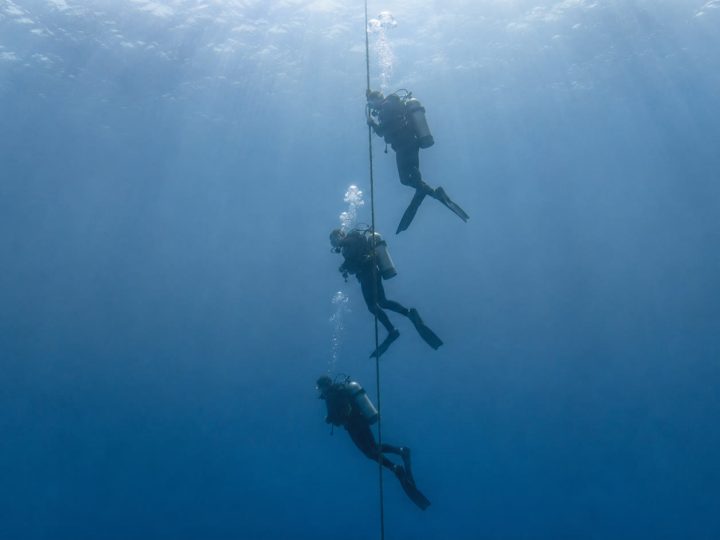
Ascent rate on fins and on the BCD, holding a stop in open water, surface scan and BCD inflation. And the controlled-exhalation ascent, from six metres at most, without rushing.
-
Theory, on the boat
Pressure and buoyancy, barotrauma and how to prevent it, breathlessness, the no-stop curve, reading your computer, regulations. There is no written exam at Level 1: everything is checked orally, in context.
What is included
Included in the price
- The five training dives
- Guiding by a state-qualified instructor
- Full equipment: tank, weights, BCD, regulator and wetsuit
- The loan of a dive computer
- The Niveau 1 certification card and certification fees
Not included
- The medical certificate
- Tips for instructors and guides, entirely up to you
What to bring
- A medical certificate less than a year old
- A swimsuit and a towel
- Being able to swim
- Parental consent for minors
Choose your experience
Similar options, compared line by line. Yours to choose.
Level 1
from 515 €
Level 2
from 750 €
Level 3
from 750 €
The first certification
Niveau 1 is the way into the French training pathway. It allows you to dive to twenty metres within a team led by an instructor.
What is actually assessed
Ease rather than performance. A Niveau 1 diver does not have to be fast or go deep: they have to be calm underwater, able to signal that something is wrong, and able to come back up cleanly.
Where you are, and what comes next
The French pathway, organised in levels set by the French sports code. No licence needed.
-
The entry certification
Level 1
Supervised diver to 20 metres, in five dives.
515 € You are here -
Before moving on
Allow twelve exploration dives before taking on the next step — with us or anywhere in the world, exactly as SSI asks on its side. Niveau 2 calls for solid buoyancy control: without it, the rescue exercises become hard.
-
Diving unsupervised
Level 2
Unsupervised to 20 metres, supervised to 40: the PA 20 and PE 40 ratings combined.
750 € Discover → -
Before moving on
Allow around twenty dives: independent to 20 metres, guided down to 40. Buoyancy control must be genuinely mastered. You need to be able to handle your own autonomy at 20 metres, because next you handle it at 60 — that is a big step, and it is no longer easy-going diving.
-
Full autonomy
Level 3
Unsupervised to 40 metres with no dive manager, and to 60 metres when a dive manager is present.
750 € Discover → -
What next?
The diver pathway ends here: beyond it lie supervision and teaching, which are another trade. A Niveau 3 is no longer working towards a certification — they pick their site, dive autonomously, and come back.
Frequently asked questions
From what age?
Do I need to have dived before?
How does it differ from SSI Open Water?
Will I be able to dive on my own?
Five dives, spread how?
What is included in the €515?
What if it rains?
I have a flight coming up — can I dive?
What not to do when you get out of the water
Your body takes several hours to get rid of the nitrogen it has absorbed. These waiting times are not comfort precautions: they prevent decompression sickness occurring on land, sometimes several hours after the dive.
-
Flying
12 h minimum
After a single no-stop dive. Allow 18 h if you made several dives in the day or dived several days in a row, and 24 h after a dive with decompression stops.
-
Going to altitude
Same waiting times
Above 300 metres, the effect is the same as on a plane. From Nice, the road to Peille, the Col de Turini or even the Moyenne Corniche quickly go above that height.
-
Freediving
Not the same day
Combining freediving and scuba on the same day carries a poorly understood risk of decompression sickness. If you want to do both, freedive first, or wait until the next day.
-
Hard exercise, sauna, steam room
4 to 6 h
Running, weight training, a very hot bath: anything that speeds up circulation or dilates blood vessels increases the risk just after a dive. A gentle swim is no problem at all.
If in doubt — an earlier flight, a connection, feeling unwell after the trip — call us. And if a symptom appears after a dive, call 15 (or 112) and say you have been diving: the right response is not the same.
What you can see underwater
Marine life varies with the season, the weather and the site chosen that morning. Here is what the Mediterranean off Nice most often has in store.
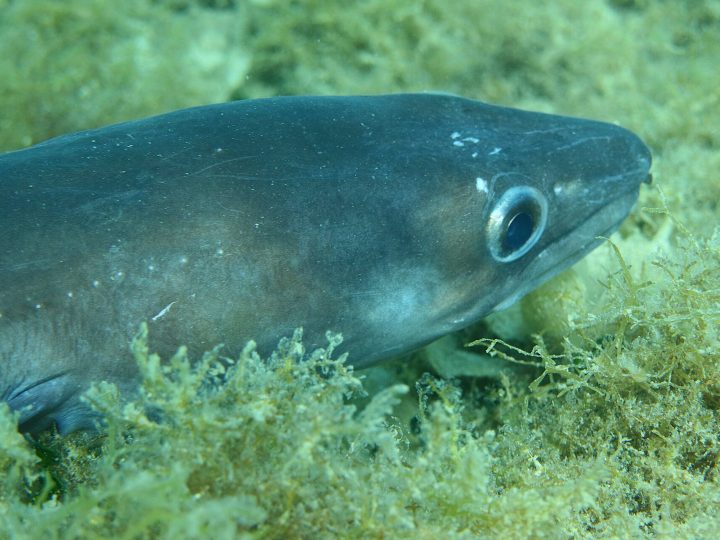
Conger eel
Crevices, boulders and wrecks, from 10 m
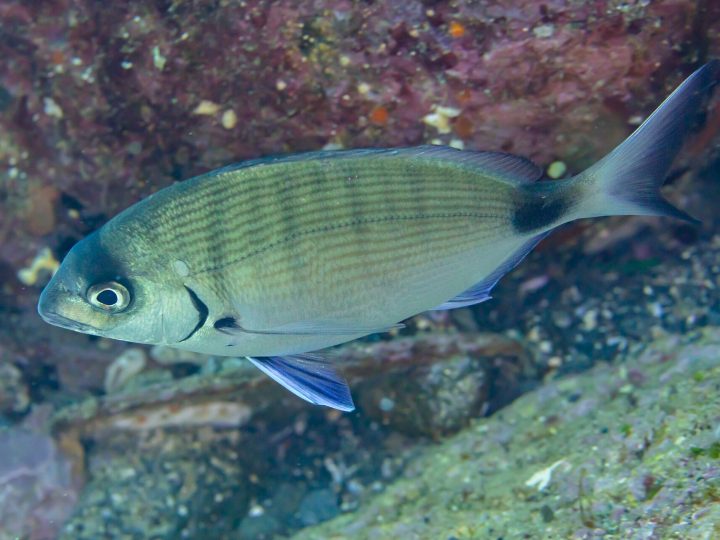
White seabream
Rocky ground, from the surface
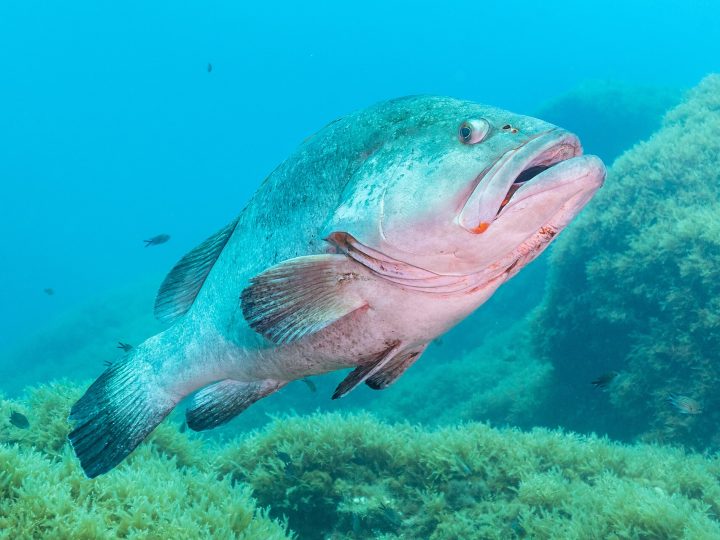
Dusky grouper
Rocky walls, from 15 m
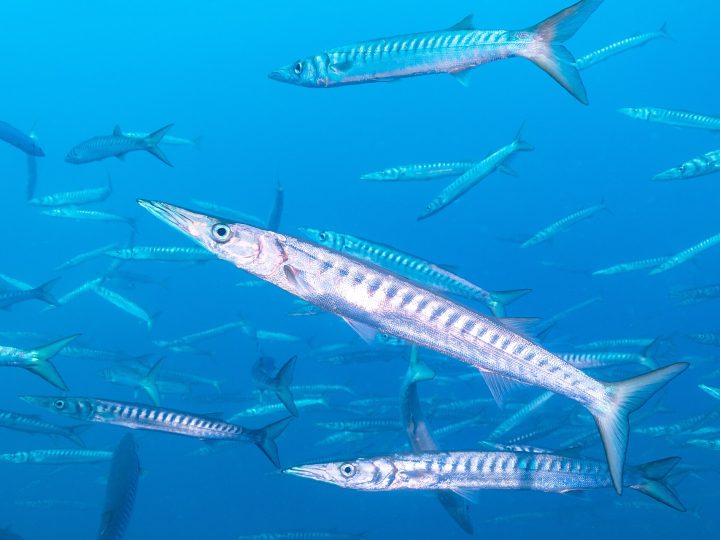
Barracuda
In open water, above the walls
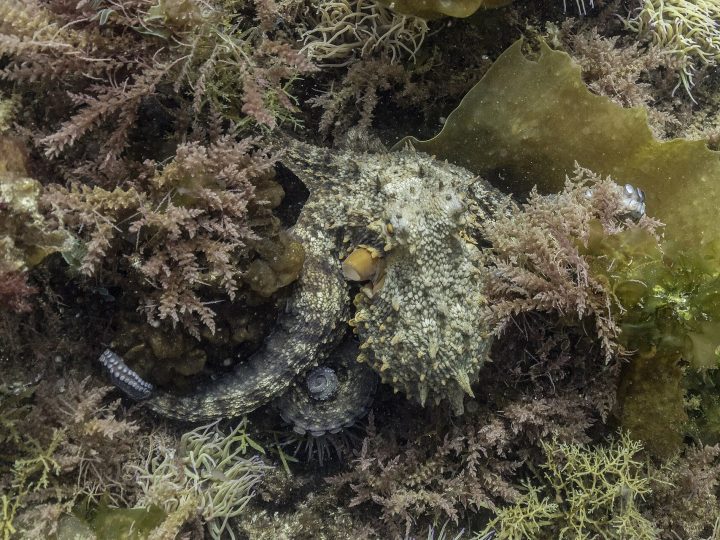
Common octopus
Rocky crevices, from 2 m
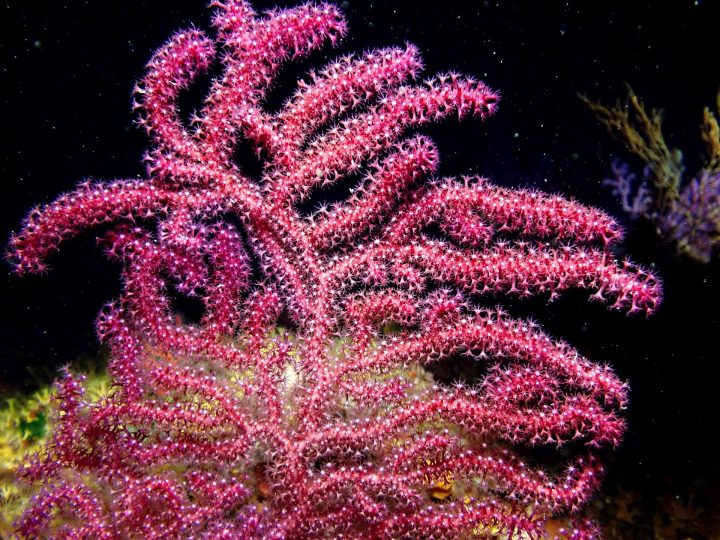
Red gorgonian
Walls, from 20 m
Photos: Holger Krisp · CC BY 3.0 · Wikimedia Commons ; Diego Delso · CC BY-SA 4.0 · Wikimedia Commons ; FredD · CC BY-SA 4.0 · Wikimedia Commons
The dive sites around Nice
From the bay of Villefranche-sur-Mer to the Mala cave, the site is chosen that morning according to the weather.

Cap de Nice
The closest area to the club: a run of walls that drop away fast, ten minutes from the…

Maeterlinck wall
A wall running out at right angles to the shore, beneath the villa that gives it its name:…
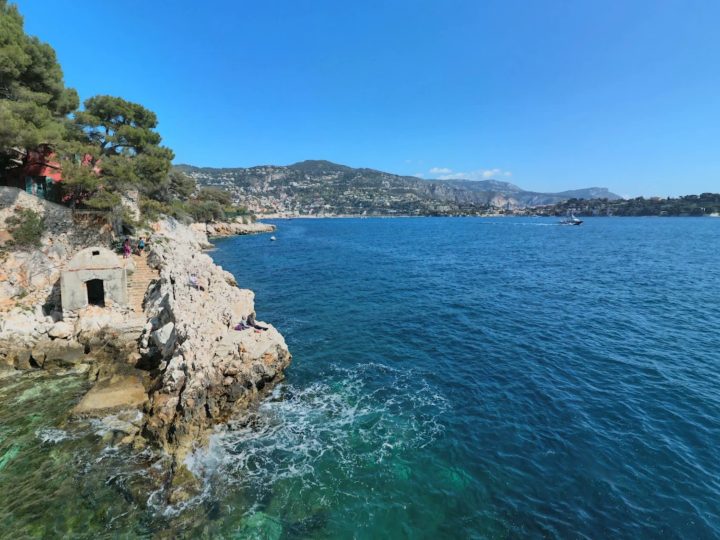
Bay of Villefranche — west side
The coral cave and the western points: the most complete dive in the bay, from the surface to…
Quai Lunel
The premises signed “Chango Diving”, in the port of Nice, next to Rent My Boat and the careening area.
- Address
- Quai Lunel
06300 Nice - Arrive
- 8.30am (30 min before departure)
Read before you come
Read up before your trip.

Your first try dive: what to expect
What actually happens, minute by minute, and the questions everyone has without daring to ask.
Open Water, Niveau 1, PADI, SSI: which certification to choose
Niveau 1 leads to sixty metres, Open Water to forty — and in France, the Code du sport does not recognise Open…
What diving in Nice really costs
From try dive to independence, what you actually pay — licence, medical certificate, certification card, equipment hire, and the point at which…
Niveau 1 or Open Water: what really changes
Six dives at sea either way, and the same level of practice at the end. But you do not get there the same way, and what follows is not the same.
| Criterion | Niveau 1 |
 SSI certification, recognised worldwide Open Water Diver |
|---|---|---|
| Minimum age | 12 years | 10 years |
| Theory | At the club, with the instructor: tables, physics, physiology | Online, at your own pace, before you come |
| Skills practised | Mask clearing, regulator recovery, assisted ascent, buoyancy, air management in a team | Mask clearing, regulator recovery, controlled ascent, buoyancy, air sharing with a buddy |
| After certification | Supervised to 20 m, with no surprises in France | Autonomous to 18 m worldwide; supervised to 20 m in France, where the Code du sport takes precedence |
| Recognition | A level set by the French sports code, recognised by every club in France | ISO 24801-2 — the international autonomous-diver standard |
| What you need on top | The card fee (€30), with no licence to take out | The SSI digital manual (€90), yours for life |
| Next steps | Level 2 (20 m autonomous, 40 m supervised), then Level 3 (40 m autonomous, 60 m with a dive manager) | Specialties, then Advanced (30 m), Master Diver, Divemaster |
| Maximum depth of the pathway | 60 metres at Level 3, of which 40 unsupervised with no dive manager | 40 metres with the Deep Diving specialty |
Neither is better. If you mostly dive in France, in a club, Niveau 1 will fit you in more naturally and leads deeper. If you dive when travelling, Open Water will spare you explaining your level at every stop. We teach both.
This course is scheduled with us
It depends on your level, your availability and the weather: we talk it through and set the dates together. WhatsApp is fastest.
Get a feel for it
Life on board, the Mediterranean, first breaths underwater and moments shared.


