
Your first try dive: what to expect
What actually happens, minute by minute, and the questions everyone has without daring to ask.
Before you leave
You arrive at the club about thirty minutes before departure. You try on a wetsuit — it should be snug, that is normal, and it is what keeps the warmth in. Fins, mask, BCD and regulator are adjusted to your size. Nobody asks you to carry anything heavy: the kit goes into the water, not onto the quay.
The passage out
A short boat trip, between ten and twenty minutes depending on the site chosen that morning according to the weather: Cap de Nice just outside the harbour, or the bay of Villefranche when the westerly gets up. This is when questions get answered and the apprehension usually dissolves.
The briefing
It happens on board, above the site. Only three things to remember: breathe and never hold your breath, equalise your ears from the first metres, and stay close to the instructor. The hand signals come down to four gestures.
The immersion
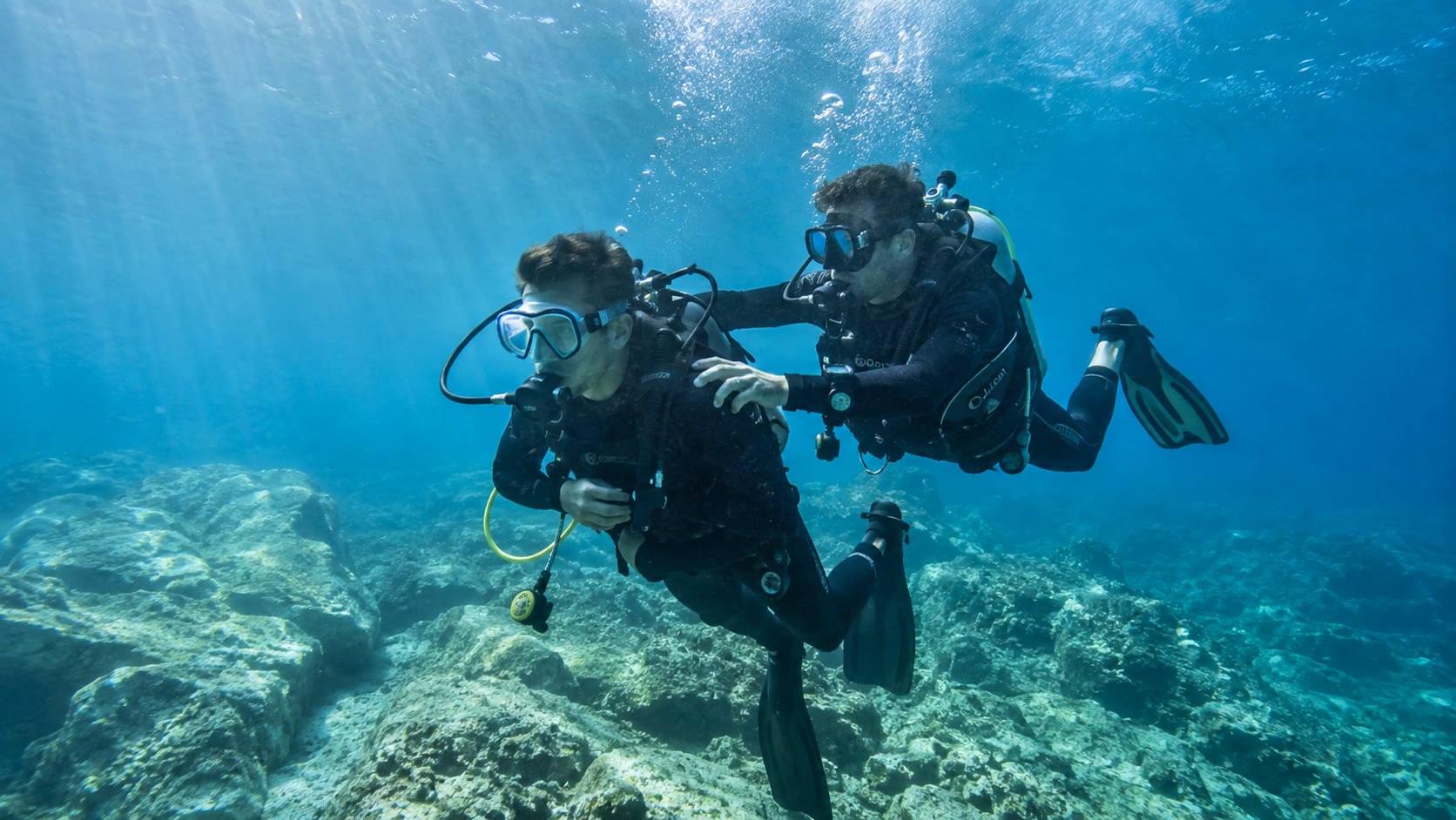
The descent is slow, along a line or through open water, over three to six metres of bottom — the bay of Villefranche most often, or the shallows at Cap de Nice. Six metres is the regulatory ceiling for a try dive in France, not caution on our part. The instructor holds you if you want. The first breath underwater is the moment everyone remembers: the brain takes two or three seconds to accept that it works.
You stay between three and six metres, rarely more. The immersion lasts around forty minutes.
The questions everybody has
What if I get frightened? It is common and of no consequence. We come up whenever you want, no discussion. Plenty of try dives begin with two minutes at the surface, just to get used to things.
What if I cannot equalise? Then we do not go down. The rule is absolute: if your ears block, we come up half a metre and start again. Nobody is pushed.
Do I need to be able to swim? You need to be comfortable in the water. You will not have to swim: the BCD holds you up and the fins do the rest.
Afterwards
No flying and no altitude for twelve hours — which matters in Nice, where the airport is thirty-five minutes from the harbour by tram and the road up to La Turbie climbs fast. A good tiredness, usually. And an SSI Basic Diver card if the try dive was run in that framework — the first line of your logbook.
Ready to breathe underwater?
The try dive lasts twenty minutes and needs no certification. It is where everything starts, and it comes off the course price if you carry on.
Also worth reading
Why take the nitrox course: safety first
Nitrox does not give you time, it gives you margin — less dissolved nitrogen, so decompression sickness stays further away. The question…
Decompression tables: a century of calculations
From Haldane and his goats to the MN90, by way of the US Navy, Bühlmann and PADI’s RDP: where the numbers come…
Pressure in diving: everything starts here
Absolute pressure, Boyle's law, volumes that compress: the Niveau 1 theory lesson that explains your ears, your weighting, your gas consumption and…


