A group is not four separate bookings that happen to fall on the same day. The boat, the supervision and the schedule reorganise around you.
🛥️
The boat to yourselves
From a full group onwards, the trip is no longer shared. You choose the departure time, the site, and the pace of the two dives.
👥
Dive teams already formed
You know who dives with whom, and at what level. We fit our supervision around your organisation rather than the other way round.
🗓️
A schedule built with you
Dives, courses, snorkelling for non-divers, a rest day: the programme fits the length of your stay.
📞
One person to talk to
From the first quote to the last safety stop, the same person follows your trip. No file changing hands.
The price
What a group trip costs
Two trips for twenty divers can cost anything from one price to double: a club that comes with its own dive director and independent dive teams does not pay the same as a group we lead from start to finish. So here are worked examples rather than a price grid.
The option
The boat
From
Shared boat
You board with other customers and follow the day's programme: we choose the site and the time.
*
Price outside July and August. In high season, a place on our boats goes at the public price: we then quote the trip case by case. A club trip moved to September or October costs less and dives better — visibility is better and the sites are empty.
†
Half day within the Villeneuve-Loubet to Cap-d'Ail area — where all our dive sites are. Further, towards Menton or Antibes, allow more. A full day is €1,080 on L'Émeraude and €1,210 on Le Nautile.
From twelve divers on L'Émeraude, or thirteen on Le Nautile, chartering works out cheaper than the shared price — and you choose the site and the time. The calculator below works it out for your group.
The boat is confirmed with the quote, and reminded at the meeting point on the quay. See the boats in detail
How much for your group?
On a shared boat, outside July and August, with your own dive director and your own gear. Cylinder, weights and computer included.
Ten minimum, twenty-four maximum: that is Le Nautile's capacity, skipper not included.
Allow two dives a day: eight is four days.
Per diver
For the groupfrom
Saved
A “from” estimate, outside July and August, excluding equipment hire. In high season, the trip is quoted case by case. The quote remains the only commitment — and it will never exceed our public prices.
Advice we give against our own immediate interest: with ten, the shared boat is almost always the right choice. Chartering becomes worthwhile from fourteen or fifteen divers, when the boat price splits enough to fall below the per-head rate — and then you also choose the site and the time.
What moves the price
How many divers, and whether that fills the boat
How many dives over the stay
Who acts as dive manager: your staff or ours
Autonomous teams, or teams led by our instructors
The season — an October trip is not priced like an August one
Equipment: yours, or ours
Any courses slotted in among the fun dives
Non-diving companions, snorkelling or staying aboard
What does not move
Four divers per instructor at most, whenever we supervise
Departure from Quai Lunel, in the heart of the port of Nice
The ceiling: never more than the published public rate
A dive computer lent, with cylinder and weights included
The Riviera fills up in July and August. It dives best in September and October. A group that shifts its trip by six weeks wins on everything: visibility, quiet sites and the price of a bed.
April — May
🌡️
14 to 17 °C
For well-equipped groups
The water is still cold and you need a good suit, but visibility is often the best of the year and the sites are completely free. This is the season for nudibranchs and spawning.
June
🌡️
18 to 21 °C
A good compromise
The temperature climbs fast and the thermocline is sharp: warm at the surface, cool at depth. The crowds have not started, and neither have hotel prices.
July — August
🌡️
23 to 26 °C
Avoid as a group
It is the warmest period, and the only one we advise a group against: a saturated port, contested moorings, accommodation at peak prices. We tell you before you book the tickets, not after.
September — October
🌡️
21 to 25 °C
The best window
The water stays at its summer temperature — the Mediterranean takes weeks to cool — while the crowds have gone. Visibility rising, sites to yourselves, hotel rates coming back down. If you only get to pick one week, pick this one.
November — March
🌡️
13 to 18 °C
For the coralligenous reefs
The water is cold, but this is when you see furthest. Walls appear all at once instead of emerging from the haze at three metres. For well-equipped groups used to the cold.
Sample trips
Three ways to plan the week
These are outlines, not packages: they get rebuilt with you. Above all they show something nobody mentions before the tickets are booked — coming by train gains you half a day of diving over coming by air.
Weekend · by air
Three to four days, arriving by air
Tram line 2 runs from terminal 2 to its Port Lympia terminus, five minutes from the boat, with no change. Allow thirty-five minutes; trams run every eight minutes, from 5.20 a.m. to past midnight.
Day 1 — arrivalTram from the airport, check in, a wander through Old Nice. No diving on the day of a long flight: you start rested, not wrung out.
Day 2 — two divesCap de Nice and the Virgin of Rauba Capeu, five and ten minutes from the quay. Close sites, gentle depths: this is the settling-in day. Afternoon at the cours Saleya.
Day 3 — two divesThe bay of Villefranche, one side in the morning, the other after the surface interval. End of day on Castle Hill, going up by lift.
Day 4 — no divingTwelve hours minimum between the last dive and take-off: the morning is free, not underwater. Market, coffee, tram, plane.
Weekend · by train
The same weekend, half a day more diving
Get off at Nice-Ville, tram 1 to Garibaldi, fifteen minutes from the port. And above all: no waiting period before a train. You can dive on the morning you leave, which a flight rules out.
Day 1 — arrival and one diveArrive in the morning, drop the bags, one dive in the afternoon at Cap de Nice. The trip starts the same day.
Day 2 — two divesSaint-Jean-Cap-Ferrat, la Caussinière and the Grand Hôtel. Afternoon at the Villa Ephrussi, directly above the morning's walls.
Day 3 — two dives, then the trainVillefranche in the morning, back at the quay early afternoon, train at the end of the day. Six dives instead of four, for the same number of nights.
One week
Seven days, ten dives, the whole coast
Over a week, the order matters as much as the count. We start close and shallow, go deep mid-week once everyone is at ease, and keep one non-diving day that serves as both rest and weather buffer.
Day 1 — arrivalCheck in, trip briefing with the dive manager, equipment and certification checks.
Days 2 and 3 — settling inCap de Nice, the Virgin, the bay of Villefranche. Four dives between ten and thirty metres to get the reflexes back.
Day 4 — no divingThe Oceanographic Museum of Monaco, or simply nothing. This day is also the buffer: if a windy day falls during the week, this is the one that moves.
Days 5 and 6 — the deepThe Américains wall and Saint-Jean-Cap-Ferrat, where the rock drops to sixty metres. This is the point in the week where a Level 3 really earns its keep.
Day 7 — the wreck, or the journey homeThe Toulonnais wreck at Monaco if the group leaves by train or car. If the flight is that evening, there is no diving: twelve hours, no exceptions.
What you come to see
Coralligenous reefs, the reason to go to thirty metres
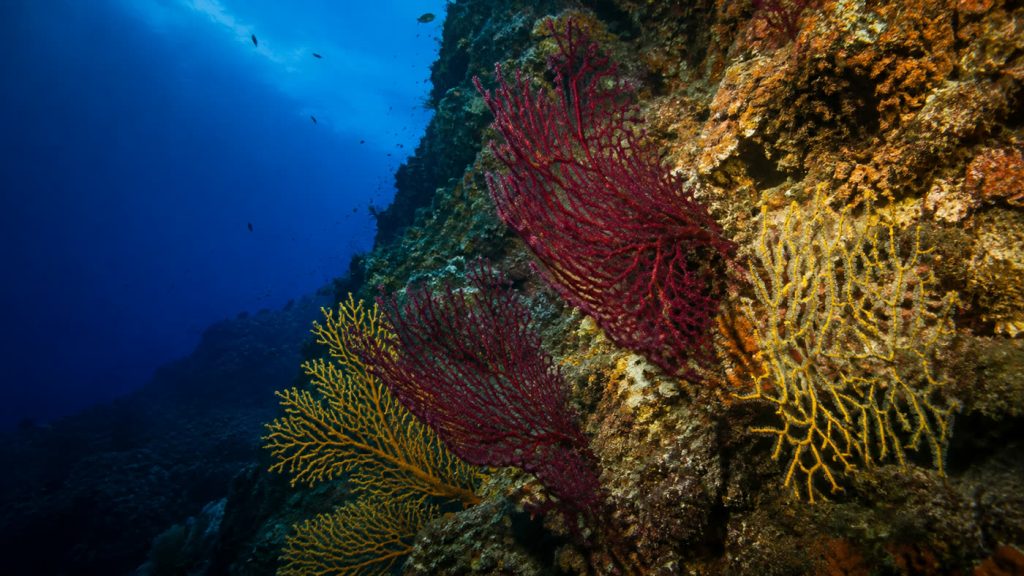
It is the most remarkable formation in the Mediterranean: structures built by calcareous algae, colonised by red and yellow gorgonians, sponges and bryozoans. A gorgonian grows about a centimetre a year — the metre-wide fans on our walls are as old as your parents.
You find it from twenty-five to thirty metres down, on walls exposed to the current. Which is to say it is not a beginner's dive: it takes a Level 2, an Advanced or the equivalent, and a group at ease at depth.
The reef is there all year. What the season changes is how much of it you see: at thirty metres, the difference between eight metres of visibility in August and twenty-five in November decides whether you discover a wall or just the tips of your fins.
The sites
Where we will take you
All less than thirty minutes' sailing from Quai Lunel. Over a stay of several days, a group works through them without ever repeating a dive.
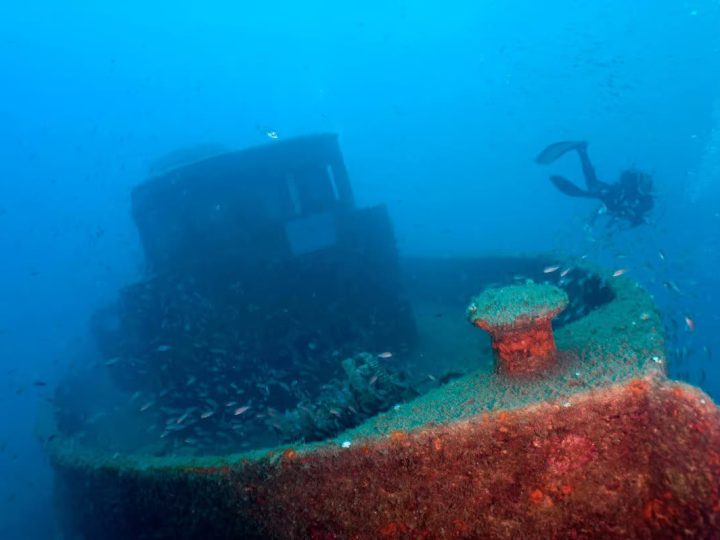
A twenty-seven metre tug sitting in thirty metres of water at the foot of the Oceanographic Museum of Monaco.
On the ground
Where to put your group up
We do not sell accommodation and we take no commission anywhere. This is what we observe from the quay, season after season — and what genuinely matters to a group diving every morning.
5 to 10 min on foot
The port and lower Riquier
The choice that simplifies everything: you walk to the boat, tanks and suits in hand. Mid-sized hotels and rentals, at reasonable rates off season. This is what we recommend for a group diving every day.
15 min on foot, 5 min by tram
Old Nice and Garibaldi
A little further from the quay, but alive in the evening — which matters when twenty people are looking for dinner together after the second dive. Plenty of flats for groups who would rather split into shares.
20 min on foot, 10 min by tram
The seafront, off season
In October and November, hotels on the Promenade drop to rates they will not offer again come spring. A group that shifts its dates by six weeks often sleeps better for less than it would in August near the port.
Tell us the size of the group and your budget per night: we will point you to the places our groups come back happy from, with nothing in it for us.
At the table
Where to eat after the second dive
Nice has a real cuisine, and it is not on the Promenade. These are the places we send our groups, with the walking time from the boat — we have no stake in them beyond not steering you wrong.
Socca
Chez Pipo
The absolute classic of Niçois cooking: socca, pissaladière, chard pie and lemon meringue tart. You eat elbow to elbow at long tables, and it is quick — which matters when you head back out in the afternoon.
Convivial Mediterranean cooking, made for sharing: exactly what a team that has just come out of the water and wants to eat from the same dish needs. Also the closest to the quay.
No menu, just stops along the way: the chef cooks for you — you simply say what you do not eat and let them work with the market's produce. This is the table we save for the last night.
Cooking rooted in local produce, as the name suggests. Six minutes from the boat: the shortest distance between peeling off a wetsuit and sitting down to eat.
Nice's historic ice cream shop on Place Rossetti, with dozens of flavours, some genuinely surprising. The compulsory afternoon stop, especially with children.
Tell us how many of you there will be and we will call ahead: a group of twenty does not turn up without a booking, and these rooms are small.
Between dives
What to do before you leave
All of them follow the same rule as our activity pages: no intense effort for four to six hours after a dive. A steep coastal hike on a forty-metre day is a bad idea, however beautiful it is.
The view, effortlessly
Castle Hill
A panoramic view over the Baie des Anges and the port you left that morning. Take the lift from the Quai des États-Unis rather than the steps: after a dive is not the time for a climb.
Arguably the finest view on the coast: from the fort you see Nice, Villefranche, Saint-Jean-Cap-Ferrat, and the Alps on a clear day. Bus to the base then a walk, or car with free parking.
The path runs directly above the seabed you dived that morning: cliffs, turquoise water, and Cap Ferrat at every turn. Flat and easy, it suits a diving day.
For the day you are not diving. The museum overlooks the Toulonnais wreck, lying thirty metres down at the foot of its rock. Direct train from Nice, twenty minutes, then a quarter of an hour on foot.
Four pieces of information are enough to price a trip. An answer within 24 hours, with a day-by-day programme — and, if your dates are not the best ones, a suggestion that is.
Discover the pleasure of going underwater on a single breath. Leaving from the Port of Nice, learn to relax and make your first descents with a state-qualified instructor, at your own pace.
Two 30-minute dives between 0 and 6 metres to learn a diver’s first skills, with the SSI Basic Diver card — and one dive deducted from your Scuba Diver or Open Water.
One or two dives on the finest sites between Nice, Villefranche-sur-Mer and Cap Ferrat, in small groups: independent or guided, with or without your own gear.
New to diving, or months without a dive? The refresh dive (SSI Scuba Skills Update): we review the skills at the start of the session, then head off on an exploration dive.
Five dives, five specialities sampled: depth, navigation, buoyancy, night or wreck depending on conditions. This is the level that opens up thirty metres.
All about nitrox — what it is, what it changes, its limits — and our two courses in Nice: Nitrox 32/40 in 2 dives, then Decompression Diving – Advanced Nitrox in 4 dives.
Scuba diving
Nitrox 32/40 and Advanced Nitrox course in Nice
From
160 €
Duration
2 or 4 dives
Level
Open Water or Niveau 1 (Nitrox) · Deep and 24 dives (Advanced Nitrox)
Learning to spot stress in yourself and in others, to prevent an incident, and to act effectively if one happens. This is the course that changes how you dive the most.
Each specialty goes deep on one subject: enriched air Nitrox, deep diving, underwater navigation, perfect buoyancy, wreck diving. Pick them according to what you want to explore.
Learn to freedive or build on your first experiences with a progressive course from the Port of Nice. Over four sessions at sea, develop your ease, your technique and the skills needed to freedive with a buddy, in the setting of the bay of Villefranche-sur-Mer.
Go further after the Freediver: over six sessions at sea from the Port of Nice, learn Frenzel equalisation, free fall and deep-water safety techniques, to progress step by step towards 30 metres in the bay of Villefranche-sur-Mer.
Train at depth in the bay of Villefranche-sur-Mer, a world-class freediving spot ten minutes from the Port of Nice: semi-autonomous sessions in groups of 3 to 4 freedivers per station, under the supervision of a state-qualified instructor.
Freediving
Freediving training sessions
From
45 €
Duration
1 session
Level
Freediving certification including deep-water rescue (SSI or equivalent)
Individual follow-up by a state-qualified instructor, four freedivers at most, at depth in the bay of Villefranche-sur-Mer: after an assessment, your progression is built around your sticking point — equalisation, relaxation, technique or apprehension.
Freediving
Freediving coaching
From
70 €
Duration
1 session
Level
Certified freediver, or practising with a club or school
Go beyond 30 metres: over eight sessions from the Port of Nice, learn mouth-fill equalisation, deep free fall, adapting to pressure and deep-water rescues, with four students maximum.
The coastal licence at the Chango Sea boat school, 14 quai des Docks on the Port of Nice: theory online and in class, exam arranged, practice at sea from Villefranche-sur-Mer. From age 16.
The offshore extension of the coastal licence, at the Chango Sea boat school on the Port of Nice: chart navigation, tides, instruments. No more distance limit.
The restricted radiotelephone certificate (CRR), required to use a VHF in Monaco, Italy and beyond French waters. A short course at the Chango Sea boat school, Port of Nice.