
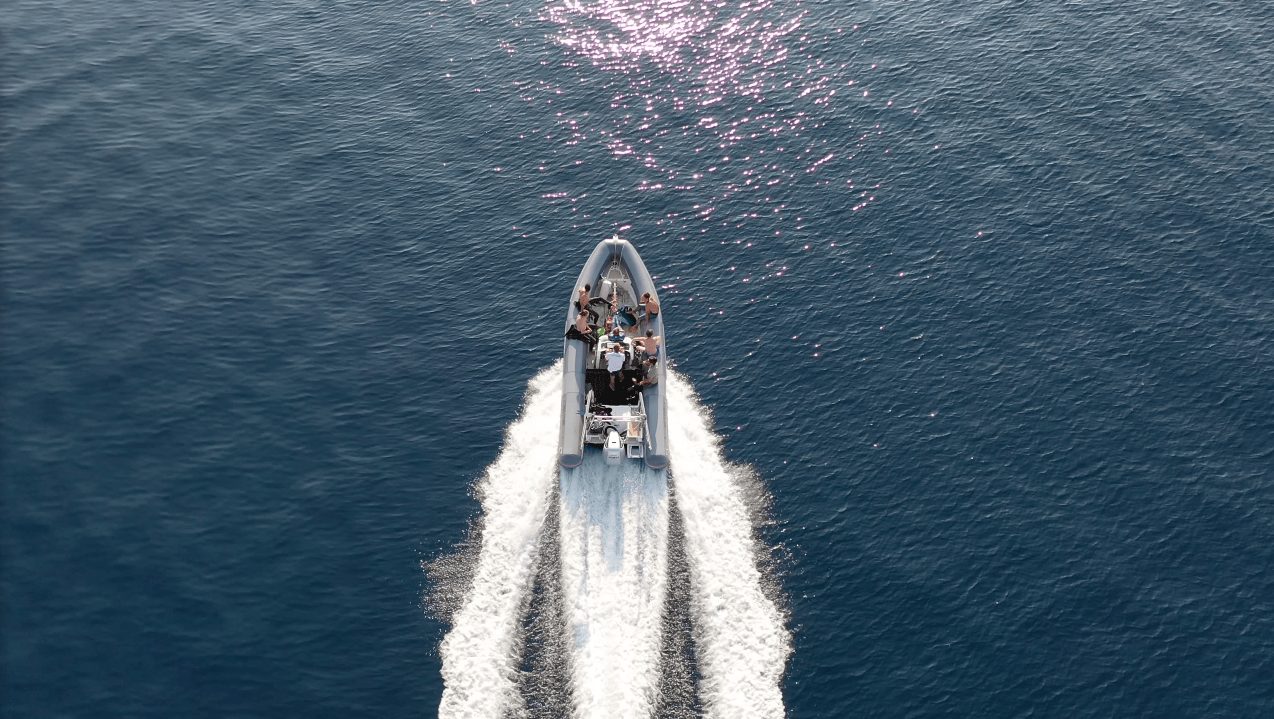
Boat speed and restricted zones: the 300-metre strip
Near the coast, speed is limited and some zones are closed to boats. What the rules say, and how to spot them from the helm.
At sea there are no speed-limit signs. Yet near the coast the rules are strict, because that is where swimmers, divers and small craft are. Here are the ones every skipper should know on the Côte d’Azur.
The 300-metre strip
Within the coastal strip of 300 metres from the shore, speed is limited to 5 knots, about 9 km/h. It is the general rule in the Mediterranean; towns and the maritime prefecture can tighten it locally.
Five knots is a speed that makes almost no wave. If your boat leaves a marked wake, you are going too fast.
Swimming zones
In summer, zones reserved for swimming are marked with yellow buoys. They are closed to all motorised craft, even at tick-over. A swimmer is very hard to see from the helm: never go near.
Access channels
To reach or leave the beach, use the buoyed channels where they exist: a lane marked by buoys, to be followed at right angles to the shore and at no more than 5 knots. It is also the compulsory route for jet skis.
Ports
In ports, speed is usually limited to 3 knots, depending on each port’s rules. Harbour entrances are narrow and busy: go in slowly, keep to starboard, and give way to vessels manoeuvring.
Divers
A white and blue flag (the “Alpha” flag) or a buoy signals divers below. Pass wide, slowly, and at a good distance: divers can surface anywhere around the boat. Our article the navigation rules in the Mediterranean covers this signal.
Other zones to know
- Regulated anchoring zones and Posidonia seagrass, where you do not drop anchor: see anchoring without harming Posidonia.
- Port approaches and access channels, to be kept clear for merchant ships and ferries.
- Temporary exclusion zones: water events, fireworks, rescue operations. They are announced by the harbour office and on VHF.
Why these rules
Most serious accidents near the coast involve a boat going too fast and a swimmer or diver. These rules are not there to spoil the trip: they let everyone share the same space.
Speed rules, buoyage and right of way are part of the coastal licence course at the Chango Sea boat school, on the Port of Nice.
We teach the boat licence
Coastal, offshore, radio certificate: theory at the Port of Nice, practice at sea from Villefranche-sur-Mer, until you pass.
Also worth reading

Boat licence in Villefranche-sur-Mer: practice in the bay
Coastal licence practice in one of the finest bays in the Mediterranean: why it is such a good place to learn, how…

Carrying passengers by boat: NUC, BACPN, Capitaine 200 and professional training
Boat trips, rental skipper, dive boat: as soon as passengers pay, you need an NUC-approved boat and a professional title. A guide…
Large craft inland waters extension: driving a boat over 20 metres
Barge, houseboat, large river craft: from 20 metres, the inland licence is no longer enough. Conditions, training and paperwork for the large…


