
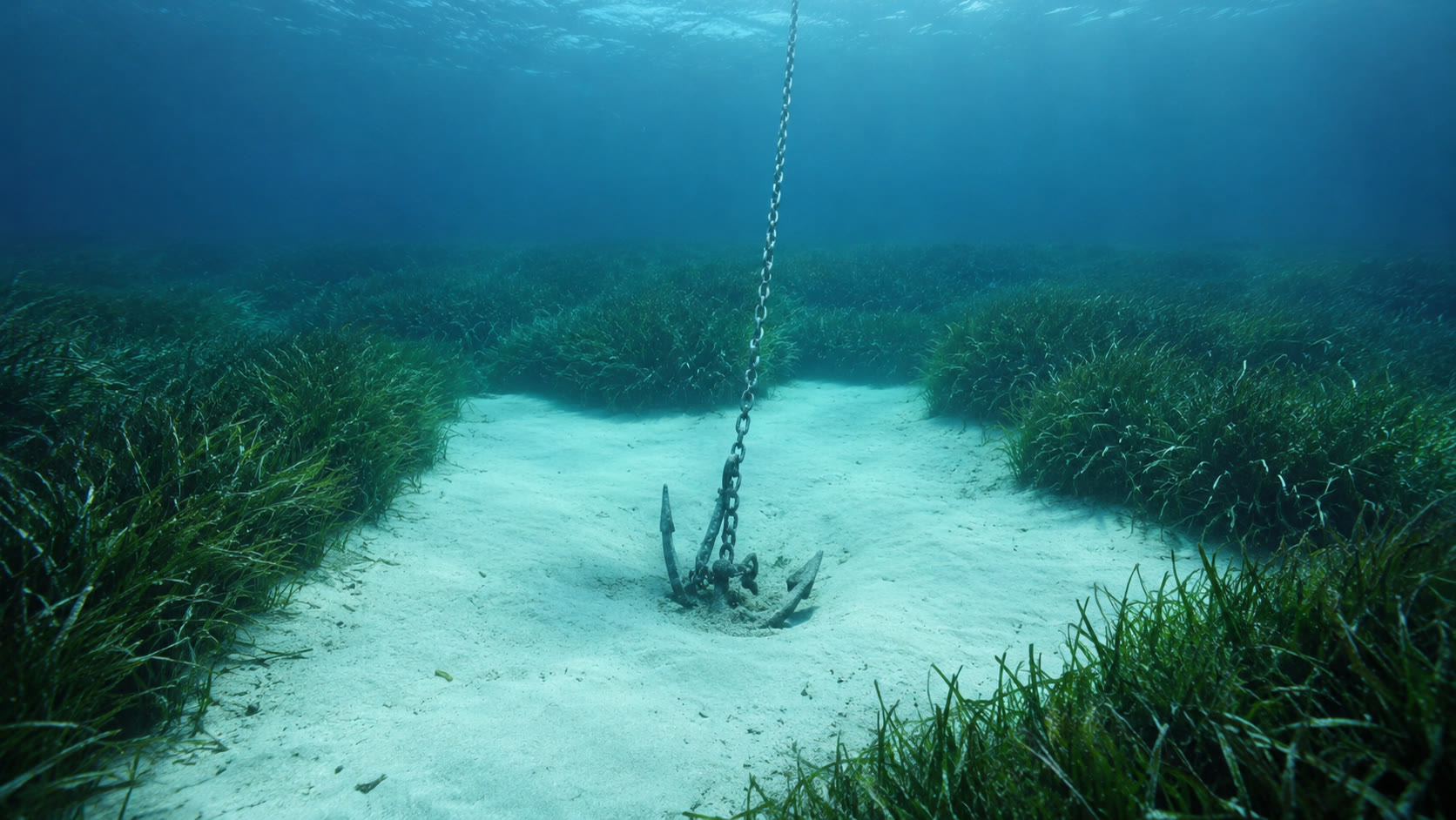
Anchoring in the Mediterranean without destroying the seabed
Where to drop your anchor, how to recognise a Posidonia meadow, and why the rules have tightened on the Côte d'Azur.
Posidonia, and why it changes everything
Posidonia is not an alga but a flowering plant that lives underwater, endemic to the Mediterranean. Its meadows shelter half of coastal life, produce oxygen and hold the sediment that keeps the beaches in place.
It grows about a centimetre a year. A meadow torn up by an anchor takes decades to recover — when it recovers at all.
What the regulations say
Posidonia has been a protected species since 1988: uprooting or destroying it is forbidden. Since 2019, the maritime prefecture has also regulated anchoring in the French Mediterranean. For vessels of 24 metres and over, anchoring in a meadow is simply prohibited, and satellite monitoring has been stepped up.
For a smaller pleasure boat there is no general ban, but there are regulated zones where anchoring is forbidden or limited to mooring buoys, and a common-sense obligation: an anchor that tears up a protected plant is still an offence. So the practical rule does not change — never on the seagrass.
How to recognise a meadow
From the surface, a meadow appears as a dark, almost black patch standing out sharply against pale sand. In clear water the difference is visible in several metres of depth.
The practical rule: anchor on the light, never on the dark. If in doubt, put on a mask and go and look — it takes two minutes.
Good practice
Choose an area of clean sand. Pay out enough chain — at least three times the depth of water — so the anchor works flat rather than ploughing. When weighing, come up vertically above the anchor before pulling.
More and more areas now offer eco-moorings: they avoid all contact with the bottom, and are often free.
Where to anchor around Nice
The bay of Villefranche has large areas of sand, but its meadows are designated and clearly identified — anchoring charts are available from the maritime authority. Beaulieu bay and the Passable inlet have marked zones.
When the anchor drags
Once anchored, pick two landmarks ashore that line up — a bell tower in front of an aerial, a rock in front of a villa. If they shift, the boat is moving: the anchor is dragging. Do not pull on it to make it bite, it will plough. Weigh it fully and try again a little further on, on clean sand.
A boat dragging across a meadow cuts a furrow several metres long. Divers know them well: those bare trenches, edged with torn-up rhizomes, that you come across in the middle of Posidonia meadows and that never close up.
Organised mooring areas
To reconcile boating with protecting the seabed, more and more bays are fitted with mooring buoys fixed to anchors that do not touch the seagrass. Where they exist, use them rather than dropping anchor next to them: that is what they are for, and they are often the only option allowed in protected areas.
What divers see
From the bottom, the difference between a good anchorage and a bad one is obvious. An anchor set on sand, chain lying flat, leaves only a mark that disappears with the next swell. A chain sweeping across a meadow as the boat swings shaves everything in a circle several metres wide.
To understand what grows in these meadows and why they matter so much, read our article on Posidonia meadows. And if you are preparing your licence, anchoring rules are part of the coastal licence course.
We teach the boat licence
Coastal, offshore, radio certificate: theory at the Port of Nice, practice at sea from Villefranche-sur-Mer, until you pass.
Also worth reading

Boat licence in Villefranche-sur-Mer: practice in the bay
Coastal licence practice in one of the finest bays in the Mediterranean: why it is such a good place to learn, how…

Carrying passengers by boat: NUC, BACPN, Capitaine 200 and professional training
Boat trips, rental skipper, dive boat: as soon as passengers pay, you need an NUC-approved boat and a professional title. A guide…
Large craft inland waters extension: driving a boat over 20 metres
Barge, houseboat, large river craft: from 20 metres, the inland licence is no longer enough. Conditions, training and paperwork for the large…


