
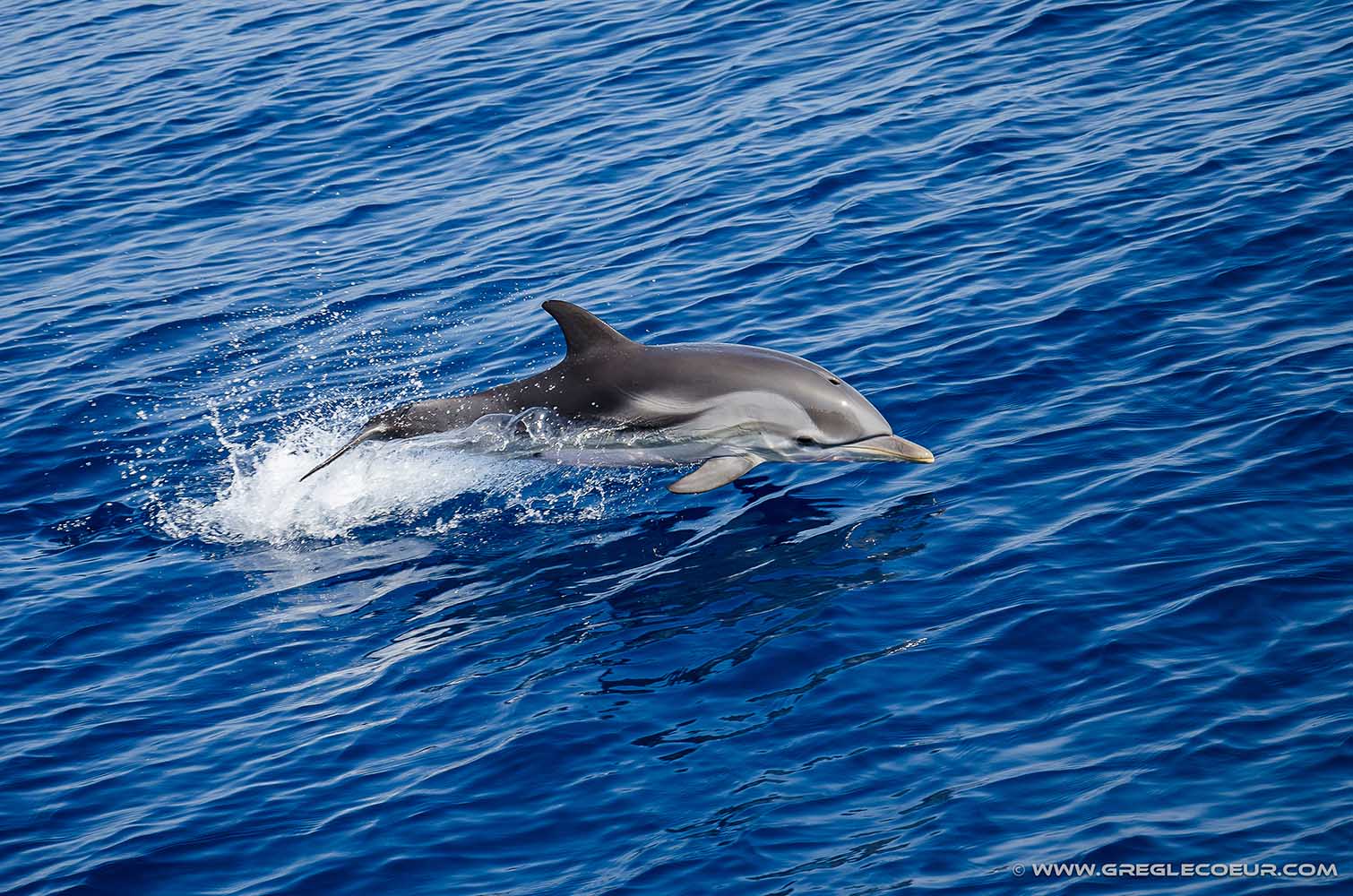
Watching dolphins by boat from Nice: good practice
Where and when you meet them off Nice, the 100-metre rule, the right way to manoeuvre near them, and the species you can see.
Meeting dolphins on a boat trip from Nice is nothing unusual: not every time, but often enough that every skipper will face it one day. You still need to know how to behave. Here is what we teach our boat school students.
Where and when to meet dolphins
Dolphins regularly come close to the coast. In summer, boat traffic and engine noise tend to push them away: encounters are more frequent early in the morning or late in the day, when the sea is calm.
Further out, the chances increase. With a suitable boat and an offshore licence, you may even meet large whales, such as the fin whale or the sperm whale, which feed at great depths.
A sanctuary on our doorstep
Nice sits in the heart of the Pelagos sanctuary, created in 1999 by France, Monaco and Italy. It stretches from the Giens peninsula to northern Sardinia and protects the marine mammals of the north-western Mediterranean. The waters off the Côte d’Azur are among its richest areas.
The 100-metre rule
In French Mediterranean waters, any deliberate approach to a cetacean closer than 100 metres is prohibited: a prefectoral order of 6 July 2021 treats it as intentional disturbance. If the animal comes closer on its own, slow down and let it, without trying to follow.
Our article seeing cetaceans in the Mediterranean: the hundred-metre rule covers the regulations in detail.
How to behave near dolphins
- Slow down: no more than 5 knots in the watching area.
- Do not cut across their path or chase them: approach slowly, from the side and slightly behind, never head-on or from directly behind.
- Keep your distance: 100 metres at least, and only one boat at a time in the close zone.
- Limit watching to 30 minutes, less with young animals present, and move away at the first sign of disturbance: sudden dives, repeated changes of direction.
- Never get in the water with them and do not feed them.
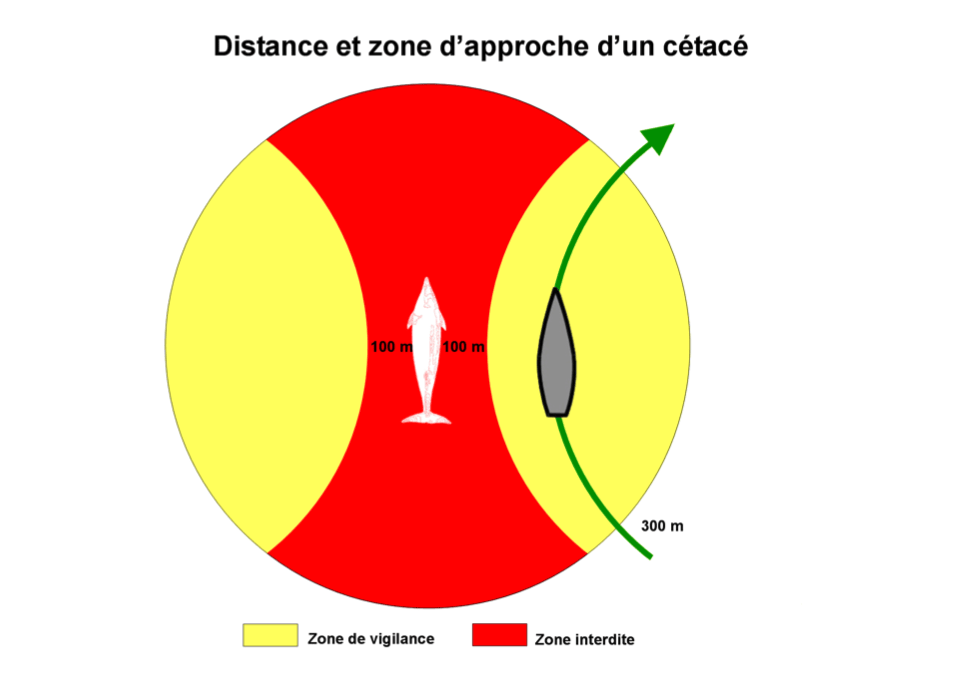
Followed carefully, these rules often bring the best encounters: at ease, dolphins stay longer, and sometimes come to ride the bow wave.
Mediterranean species
- Striped dolphin: the most widespread, very sociable, sometimes in large groups.
- Bottlenose dolphin: often near the coast, the best-known dolphin.
- Common dolphin: rarer, often mixed with striped dolphins.
- Risso’s dolphin: its body becomes covered in white scars with age.
- Long-finned pilot whale: bulging forehead, lives in tight-knit groups.
- Fin whale: the second-largest animal on Earth, after the blue whale.
- Sperm whale: able to dive beyond 2,000 metres and stay down for over an hour.
- Cuvier’s beaked whale: discreet, very sensitive to sonar noise.
Their main threats are ship strikes, accidental capture in nets, chemical pollution and underwater noise. A careful skipper is already part of the solution.
Find out more
The Pelagos sanctuary website and the High Quality Whale Watching label set out good watching practice. And if you do not have your licence yet, the Chango Sea boat school, on the Port of Nice, builds these rules into its coastal licence course.
We teach the boat licence
Coastal, offshore, radio certificate: theory at the Port of Nice, practice at sea from Villefranche-sur-Mer, until you pass.
Also worth reading

Boat licence in Villefranche-sur-Mer: practice in the bay
Coastal licence practice in one of the finest bays in the Mediterranean: why it is such a good place to learn, how…

Carrying passengers by boat: NUC, BACPN, Capitaine 200 and professional training
Boat trips, rental skipper, dive boat: as soon as passengers pay, you need an NUC-approved boat and a professional title. A guide…
Large craft inland waters extension: driving a boat over 20 metres
Barge, houseboat, large river craft: from 20 metres, the inland licence is no longer enough. Conditions, training and paperwork for the large…


