
Nice was Italian until 1860
Five centuries under the House of Savoy, a transfer to France barely more than a hundred and fifty years ago, and Garibaldi born on rue Gioffredo: what it left behind.
1388: Nice chooses Savoy
At the end of the fourteenth century, Provence was torn apart by a war of succession. Nice and its county made a choice that would last nearly five hundred years: they placed themselves under the protection of the Count of Savoy. It is known as the dedition of Nice to Savoy, in 1388.
From then on, Nice was no longer Provençal. It belonged to the States of Savoy, then to the Kingdom of Sardinia — a state whose capital was Turin and whose official language was Italian. Marseille was abroad. The river Var would later mark the border.
1860: the transfer
The return to France is recent, and it came with a political price. In 1860, by the Treaty of Turin, the Kingdom of Sardinia ceded Nice and Savoy to Napoleon III in exchange for French support for Italian unification. A plebiscite ratified the decision that spring.
Not everyone was in favour. The most famous opponent was from Nice: Giuseppe Garibaldi, born here in 1807, who regarded the cession of his birthplace as a betrayal and said so forcefully in the Turin parliament.
What it left behind
A great deal, and you do not need to be a historian to see it.
The architecture. The ochre, oxblood and yellow façades of the Old Town, the Roman tile roofs, the baroque churches: that is Italian town-building, not Provençal. Compare it with Aix or Arles and the difference is obvious.
The language. Niçois is not Italian, but neither is it the Provençal of the Rhône. The bilingual street signs of the Old Town are a reminder on every corner.
The food. Socca, pissaladière, panisses, Swiss chard pie: the Ligurian kinship is direct. Socca is first cousin to the farinata of Genoa.
The names. A Nice phone book is full of surnames ending in -i and -o. Many families settled here for generations are of Piedmontese or Ligurian origin — and never had to cross a border to become so.
And underwater?
The border matters at sea too. Monaco, twenty minutes away by boat, is a sovereign state with its own regulations; Italy begins a few miles further on. This coast has always been a crossing point between three political spaces, and that is what explains the density of fortifications you pass sailing east: every headland was used to keep an eye on somebody.
And below the surface?
The finest part of the coast is the one you cannot see from the Promenade. Two hours of snorkelling are enough to discover it.
Also worth reading
Castle Hill: the castle that is no longer there
This is where Nice was born, and nothing of the castle remains. The story of a hill razed by Louis XIV, and…
The coast from the sea: what you cannot see from the road
A pink neo-Mughal castle, a sixteenth-century citadel, a pink villa perched on a headland: the corniche makes quite different sense from a…
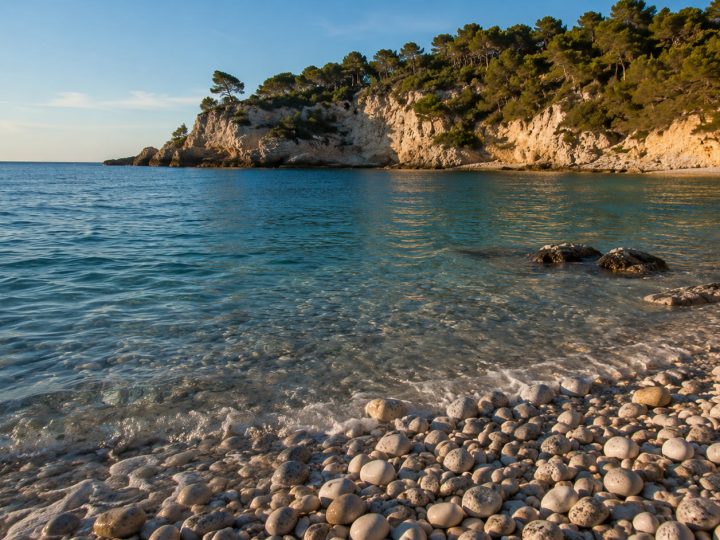
The best beaches in Nice and nearby
Pebbles or sand, public or private, family or wild: our selection along twenty kilometres of coast.


