
Castle Hill: the castle that is no longer there
This is where Nice was born, and nothing of the castle remains. The story of a hill razed by Louis XIV, and the best view in the city — by lift.
A hill with no castle
The name misleads everybody: there is no castle on Castle Hill. There was one, a considerable one, and all that remains are foundations and a few stretches of wall in the middle of a park.
And yet this is where Nice began. The rock overlooking the harbour and the bay was the obvious defensible site: the Greeks, then the Romans, then the medieval town settled there. For centuries, Nice was not the Promenade des Anglais — it was this hill and the village at its foot.
1706: the demolition
The citadel that crowned it was one of the strongest fortresses in the region, and it withstood several sieges. During the War of the Spanish Succession, the troops of Louis XIV eventually prevailed, and the king ordered its complete destruction.
Which explains the landscape today: deprived of its fortress, the town spread out onto the plain and towards the west. The Old Town you walk through is the lower part of that story, and the hill became a viewpoint again.
What you can see
Two panoramas, and they do not show the same thing. To the west, the postcard view: the Baie des Anges, the whole Promenade, the roofs of the Old Town. To the east, quieter and often deserted, Port Lympia, the boats, and Mont Boron behind — that is the side from which you can watch our morning trips leave.
The artificial waterfall, built in the nineteenth century, runs at the top. The park is free to enter, shaded, and one of the few cool places in the city in August.
Take the lift up
This is the practical advice that matters, and it holds for everyone — particularly on a diving day. A free lift runs from Quai des États-Unis, at the foot of the rock, and puts you at the top without a single step.
The alternative is a staircase of several hundred steps. After a dive, this is not the moment: our post-dive guidance advises against intense effort for four to six hours, and a climb under the August sun falls squarely into that category. The lift makes the hill a post-dive afternoon activity, which a staircase rules out.
The midday cannon
Do not jump: every day at noon, a bang rings out from the hill. The tradition dates back to the nineteenth century, when an Englishman living in Nice, tired of his wife coming home late for lunch, is said to have arranged for a cannon to be fired to mark the hour. The cannon has changed, the custom has stayed, and people in Nice still set their watches by it.
Things to see on the way
The Bellanda tower, halfway up on the sea side, is one of the few remains of the old fortifications; the composer Hector Berlioz stayed there. On the north side, the Château cemetery is lined with monumental tombs and offers one of the calmest views of the city. And here and there, open-air excavations reveal the foundations of the medieval cathedral that once stood at the top.
When to go
Early in the morning, when the light comes in from the east over the Baie des Anges and the park is still empty. Or late in the day, for the sunset over the Promenade. In between, in summer, prefer the shade of the paths to the viewpoints in full sun.
After a morning at sea with us, it is the simplest afternoon idea there is: the port is at the foot of the hill, and the lift does the rest. More ideas for your days off diving in our walks with a sea view.
And below the surface?
The finest part of the coast is the one you cannot see from the Promenade. Two hours of snorkelling are enough to discover it.
Also worth reading
Nice was Italian until 1860
Five centuries under the House of Savoy, a transfer to France barely more than a hundred and fifty years ago, and Garibaldi…
The coast from the sea: what you cannot see from the road
A pink neo-Mughal castle, a sixteenth-century citadel, a pink villa perched on a headland: the corniche makes quite different sense from a…
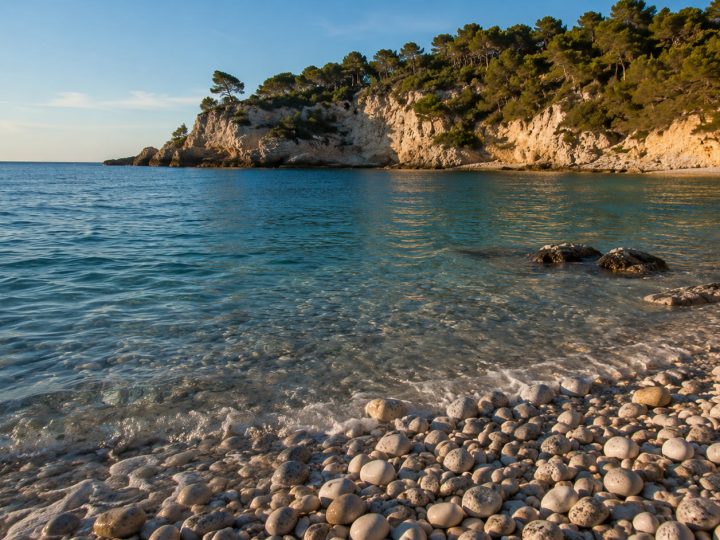
The best beaches in Nice and nearby
Pebbles or sand, public or private, family or wild: our selection along twenty kilometres of coast.


