
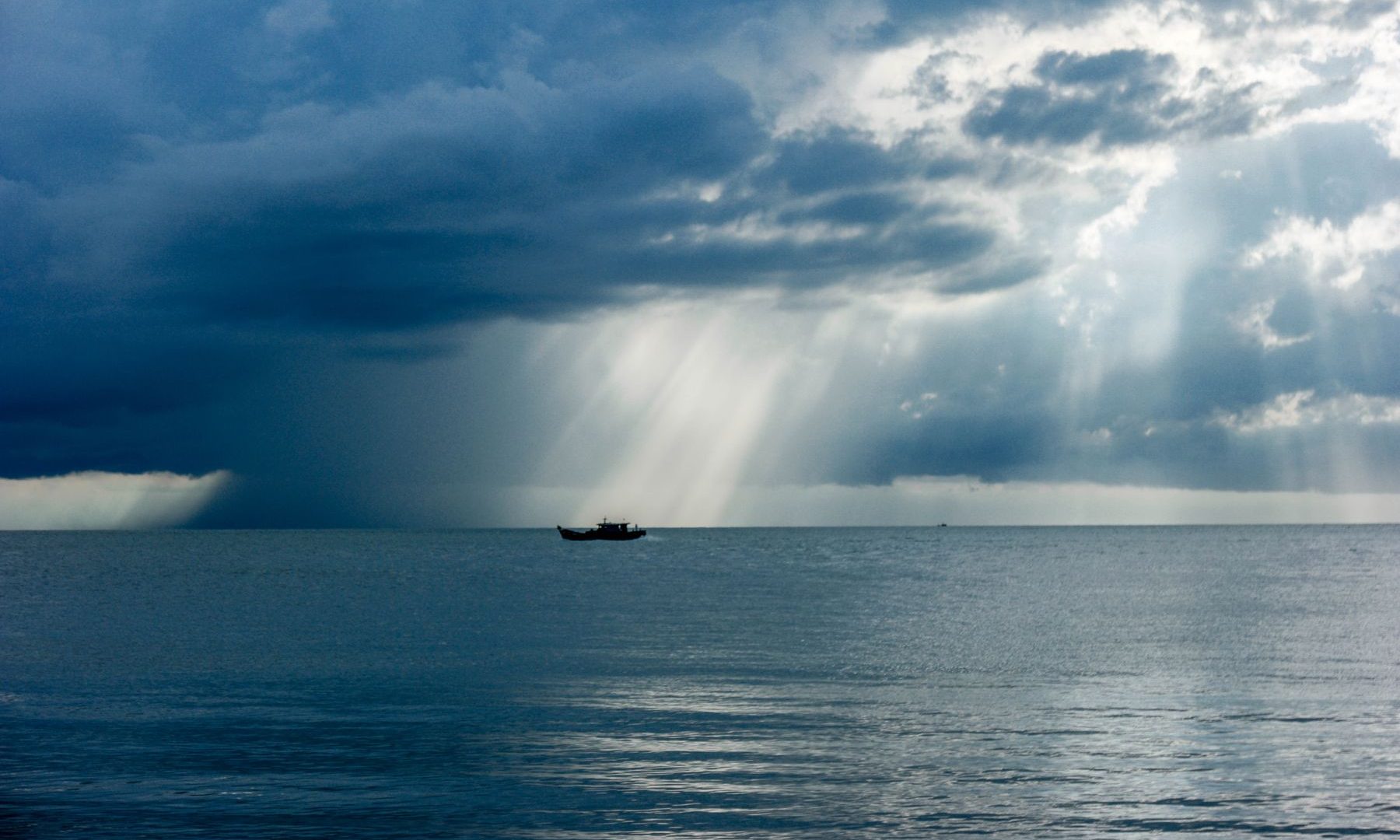
Marine weather in Nice: reading it before you head out
Where to find the forecast, how to read it, the winds that matter on the Côte d’Azur, and the simplest rule: if in doubt, don’t go out.
Weather is the first decision of any boat trip, before you even start the engine. On the Côte d’Azur the sea is often calm, but it can change quickly. Here is how we prepare our outings at the boat school on the Port of Nice.
Where to find the marine forecast
- Météo-France publishes a daily coastal bulletin, for the 20-mile strip, and an offshore bulletin. It is the official reference.
- VHF radio: the CROSS broadcasts weather bulletins at set times, announced on channel 16. Near-gale and gale warnings are relayed first.
- Apps give detailed hour-by-hour forecasts. Useful to refine, they do not replace the official bulletin.
- The harbour office posts the day’s bulletin: a glance on your way costs nothing.
Reading a bulletin
For each period, a bulletin gives the wind direction and strength, the sea state, the swell, visibility and the weather. Wind strength is given on the Beaufort scale:
- Force 1 to 3 (up to 10 knots): calm to slight sea, ideal for beginners;
- Force 4 (11 to 16 knots): moderate sea, white horses; a small boat starts to slam;
- Force 5 (17 to 21 knots): rough sea, not advised for small boats and beginners;
- Force 6 and above: near-gale warning, stay in port.
Look at the swell too: a sea raised by a distant wind can make a trip uncomfortable under a perfectly blue sky.
The winds that matter in Nice
- The sea breeze often picks up in summer afternoons, blowing onshore. Pleasant, it builds a chop by late afternoon: morning trips are the calmest.
- The easterly pushes swell into the Baie des Anges and can make the harbour entrance difficult. It is what most often closes the port: our article on the three red lights of the Port of Nice explains what to do.
- The westerly, and the mistral when it reaches this far, sometimes rise fast and strengthen off the headlands.
- Thunderstorms in summer and autumn often come over the hills: watch the sky above them.
Deciding whether to go
Ask yourself three questions: is the weather within my boat’s limits? Within mine? And if it gets worse, is there a shelter on my route? Always plan the return around the forecast trend, not just the weather at departure.
The most useful rule is the simplest: if in doubt, don’t go out. A trip can be postponed; a hard return, with seasick or worried passengers, spoils far more than a day.
At sea: keep an eye on the sky
Keep the VHF on channel 16, note the time of the next bulletin, and watch for the signs: a shifting wind, a bank of cloud, the sea building offshore. Better to head back an hour too early than an hour too late.
Weather is part of the coastal licence course at the Chango Sea boat school, on the Port of Nice: we learn it on the chart, then at sea, in the day’s conditions.
We teach the boat licence
Coastal, offshore, radio certificate: theory at the Port of Nice, practice at sea from Villefranche-sur-Mer, until you pass.
Also worth reading

Boat licence in Villefranche-sur-Mer: practice in the bay
Coastal licence practice in one of the finest bays in the Mediterranean: why it is such a good place to learn, how…

Carrying passengers by boat: NUC, BACPN, Capitaine 200 and professional training
Boat trips, rental skipper, dive boat: as soon as passengers pay, you need an NUC-approved boat and a professional title. A guide…
Large craft inland waters extension: driving a boat over 20 metres
Barge, houseboat, large river craft: from 20 metres, the inland licence is no longer enough. Conditions, training and paperwork for the large…


