
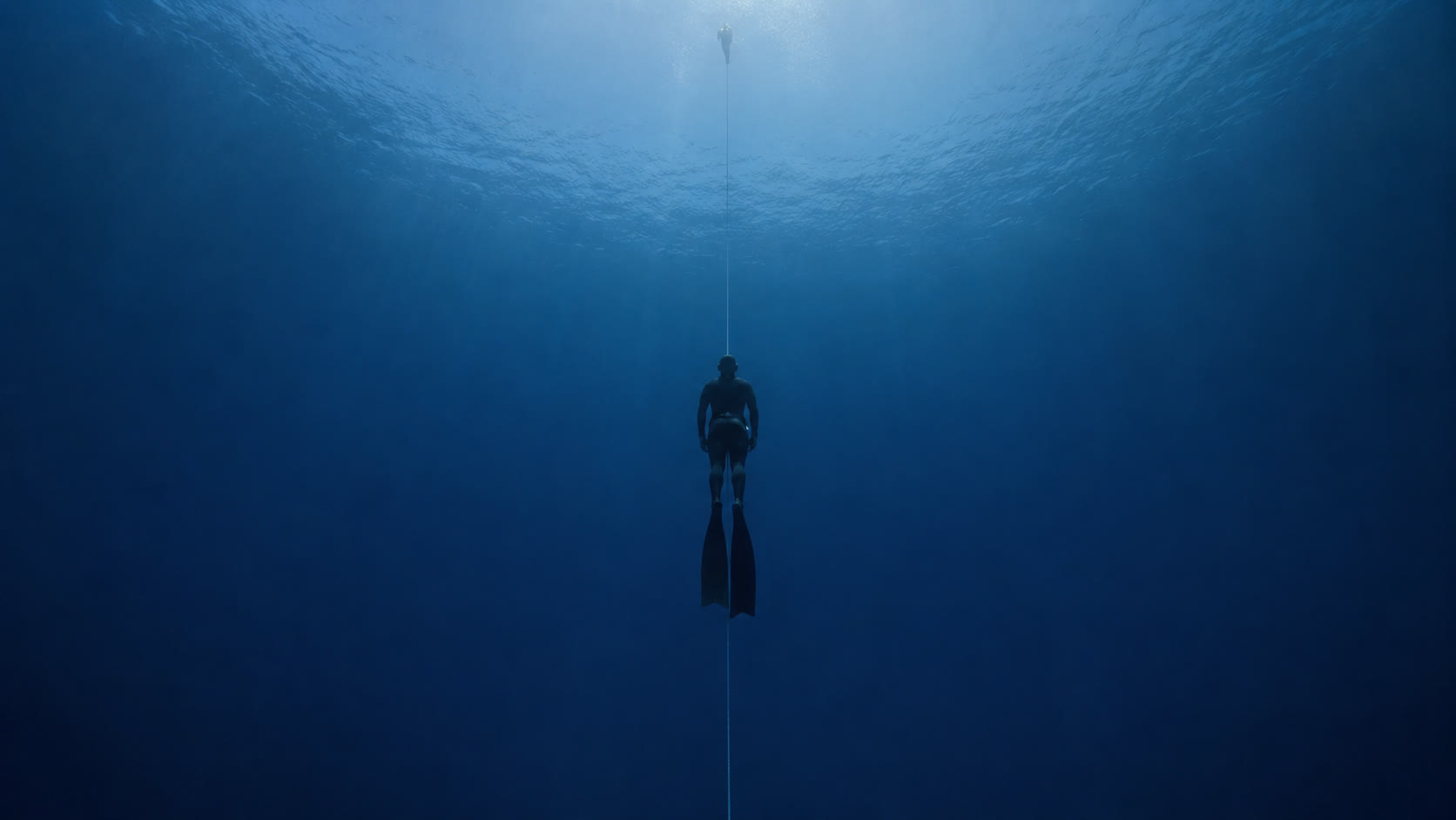
Freediving for beginners: what actually matters
No, it is not about holding your breath for a long time. What counts, what is learnt, and why you never practise alone.
It is not about performance
The first misconception is believing you have to hold your breath for a long time. In reality, recreational freediving happens between fifteen and forty seconds of immersion. What you are after is silence, slowness, and the ability to approach marine life without scaring it off — a sea bream or an octopus at Cap de Nice will let a freediver come far closer than a scuba diver and their bubbles.
What you learn first
Preparatory breathing at the surface, before every descent. Then letting go: the tenser the body, the more oxygen it burns. Next comes the duck dive — the movement that tips you towards the bottom without effort — and equalising.
Depth is never the objective of a session. It comes of its own accord once the rest is in place.
The absolute rule: never alone
This is the non-negotiable point. Freediving is always done in pairs: one goes down, the other watches and meets them on the way up. The vast majority of freediving accidents happen to people on their own, often experienced ones. A supervised beginner runs almost no risk.
From what age
We take beginners from twelve, and certifying courses from fourteen. Below that, snorkelling gives the same sensations without the physiological demands of a descent.
Do you need to be fit
No, and often it is the other way round. Well-trained swimmers sometimes find it harder to relax than beginners. What genuinely helps: a good night’s sleep, not having eaten too much, and not being in a hurry.
What the first time feels like
Pressure on the ears from the first metre, which you learn to equalise. Then, at around ten metres — a depth you reach a few minutes from the quay, at the Crau de Nao or in the bay of Villefranche — the sensation of no longer needing to fin: the body becomes heavier than the water and sinks on its own. It is that moment, the free fall, that makes people want to do it again.
The gear to start with
There is no need to buy anything for a first session. What matters is a low-volume mask — it needs less air to equalise on the way down —, a simple snorkel, fins and a wetsuit suited to the season, because you cool down fast staying still between dives. A light weight belt lets you sink without effort in the first few metres.
Long freediving fins, the emblem of the sport, are not essential at first. They become worthwhile once the technique is in place: before that, they tire you more than they help.
Classic mistakes
- Hyperventilating before going down. Breathing fast and hard feels like topping up on oxygen. In reality it mostly lowers carbon dioxide, which is the body’s alarm signal: the urge to breathe arrives later, sometimes too late. It is the most dangerous habit in freediving, and the first one you unlearn.
- Forcing your ears. If equalising does not work, go up a metre and try again. Insisting damages the eardrum.
- Diving again too soon. Recovery at the surface should last at least twice the time spent underwater. It is what makes the next dive safe.
- Coming on a full stomach, or after too little sleep. The body uses more, and relaxes less.
Starting with us
Our introductory sessions take place in the bay of Villefranche-sur-Mer, sheltered from the wind, in a small group with a state-qualified instructor who stays in the water with you. You work on breathing, the duck dive, equalising and buddy supervision, with no depth target. All our options are on the freediving page.
Try freediving, for real
A supervised introduction, with no performance and no stopwatch: above all you learn to relax. Never alone, never forced.
Also worth reading
Blackout, samba, taravana: freediving accidents
Why the urge to breathe comes from carbon dioxide and not from lack of oxygen, what that changes, and the four rules…
The freediving disciplines, explained simply
Static, dynamic, constant weight, free immersion: six very different ways of holding your breath, and the one everybody starts with.
Freediving equipment: what really differs from scuba
Low-volume mask, long fins, smooth-skin suit, minimal weighting: every item answers a constraint that scuba diving does not have.


