
Twelve species to recognise underwater in Nice
A short guide to the local Mediterranean fauna, from grouper to nudibranch, with where and when to meet them.
The ones you cannot miss
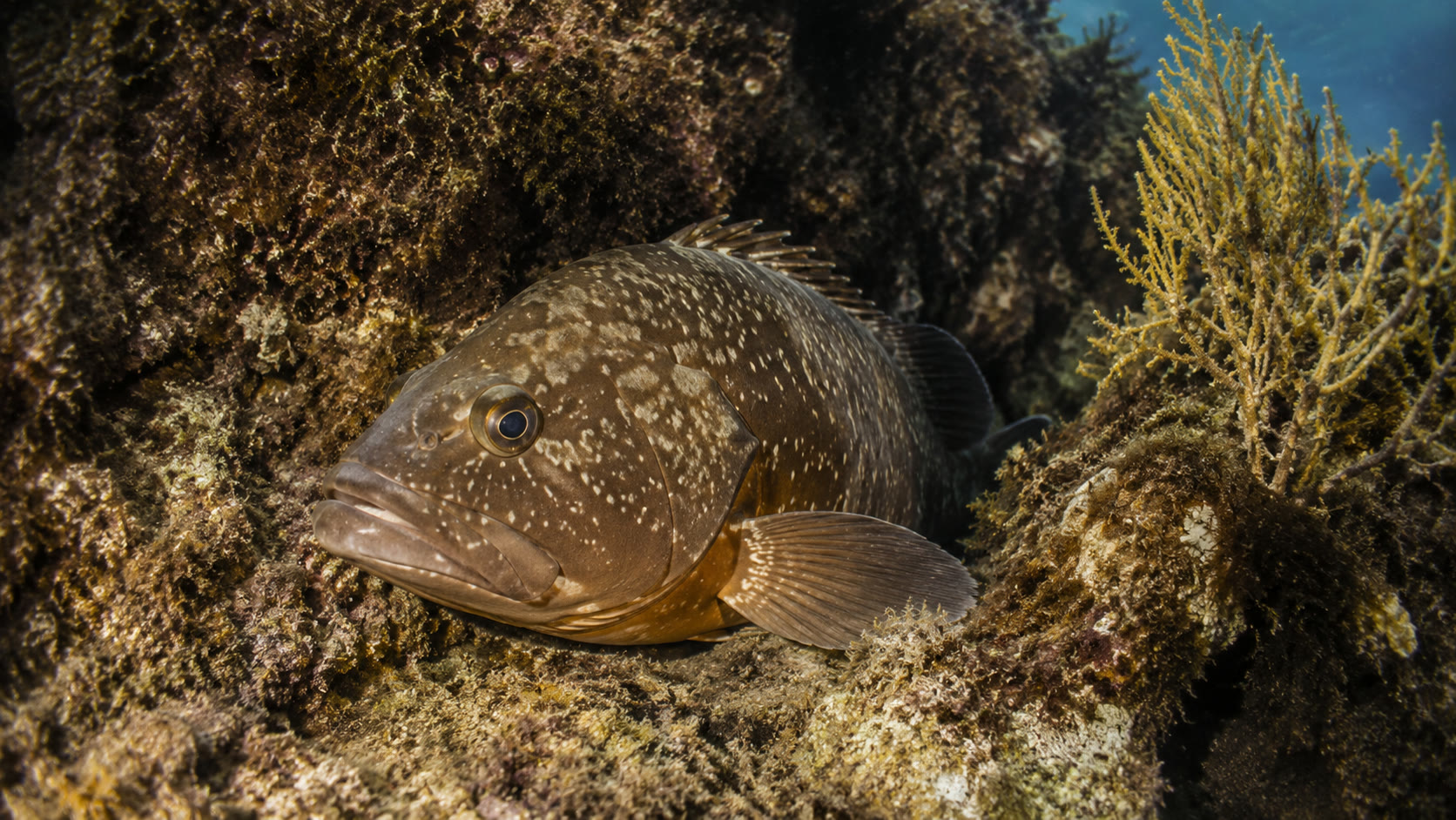
The dusky grouper. The emblematic fish of the Mediterranean. Bulky, up to a metre twenty, often motionless at the mouth of its crevice. Protected since 1980, it has regained its confidence and lets you approach. You meet it mostly on rocky walls from fifteen metres down: Saint-Hospice, at Saint-Jean-Cap-Ferrat, is one of the best grouper spots on this coast.
The white seabream. Recognisable by its dark vertical bars. Curious, it comes willingly towards divers. Found everywhere, from the surface down.
The salema. Horizontal golden stripes, in schools, always above the seagrass it grazes. It is the species you see most while snorkelling, particularly above the meadows in the bay of Villefranche and the Mala cove.
The discreet ones
The octopus. A master of camouflage, changing colour and texture in a second. Look for the eye, or for the empty shells piled outside its den.
The moray. Tucked into crevices with its mouth open — not out of aggression, but in order to breathe. Entirely harmless as long as you keep your hand out of its hole.
The scorpionfish. Motionless on the bottom and perfectly camouflaged. You swim past without seeing it. Do not touch: its dorsal spines are venomous.
The schooling fish
Damselfish. Dark clouds that close up as you approach. The juveniles are a spectacular electric blue.
Barracuda. In silver schools above the walls off Villefranche and Cap Ferrat, especially from late summer into autumn. Impressive, and not in the least dangerous.
Living landscapes
The gorgonian. Large yellow or red fans anchored to the walls from twenty metres down — the gorgonian valley at Cap de Nice and the Américains wall carry whole fields of them. They are animals, not plants, and they grow a centimetre a year — hence the rule never to touch them.
Posidonia. The underwater flowering plant that forms the meadows. It shelters half of Mediterranean coastal life and produces a significant share of the sea’s oxygen.
For attentive eyes
The nudibranch. A few centimetres of vivid colour, on rock and on sponges. The reward for those who take the time to look closely.
The red sea star. Common on rocky ground from three metres. Often the first species children spot.
One simple rule
Look, do not touch. Not the gorgonians, not the urchins, not the octopus. The fauna of this coast is dangerous to nobody — we are the ones putting it at risk.
Go and see them
Groupers, octopus, moray eels: a fun dive on the walls off Nice, with a guide who knows where they hide.
Also worth reading

Watching cetaceans in the Mediterranean: the hundred-metre rule
Coming within a hundred metres of a cetacean has been illegal across French Mediterranean waters since 2021. What the law says, what…
The changing Mediterranean: what divers see off Nice
A sea warming faster than the oceans, gorgonians dying in marine heatwaves, southern species moving north: what divers are actually seeing.
Red coral: the gold of the Mediterranean
An animal, not a stone. It grows in the dark, a few millimetres a year, and the coral cave at Villefranche has…


